
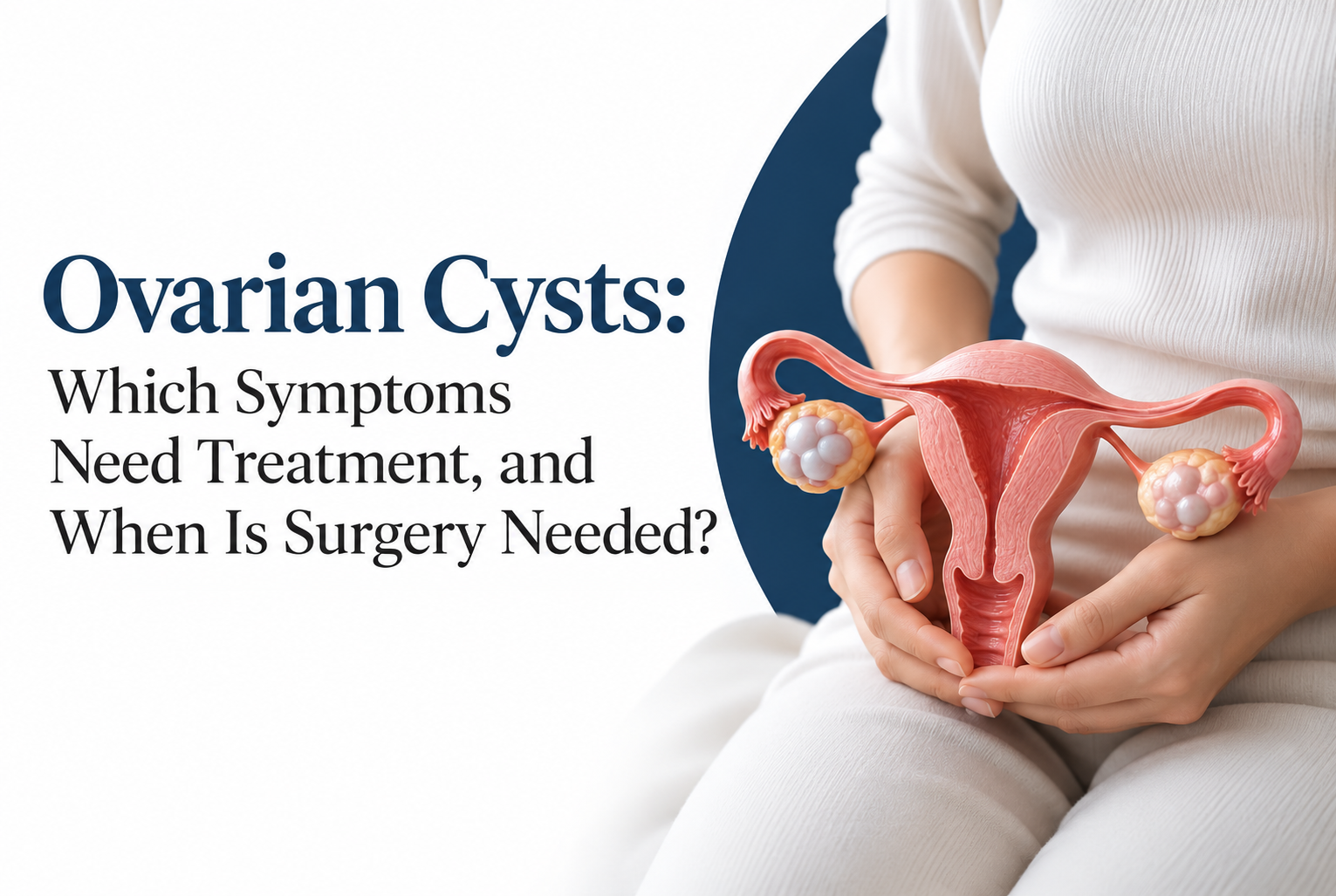
Being told you have an ovarian cyst can be unsettling, and most women’s first question is whether they’ll need an operation.
In most cases, the answer is no. Most ovarian cysts are benign, and many go away on their own. Some do need closer attention. Depending on the cyst’s size, how it looks on a scan, the symptoms it causes and your own risk factors, your doctor may suggest monitoring, medication or, less often, surgery.
It’s a sac that forms in or on the ovary. It can be filled with fluid, blood or other material.
The types we see most often are:
What the cyst looks like on ultrasound, together with your symptoms and medical history, helps decide what happens next.
Many cysts cause no trouble at all and are only picked up during a routine scan.
When they do cause symptoms, women may notice ongoing pain in the lower abdomen, a heavy feeling in the pelvis, bloating, pain during sex, or pressure on the bladder. Other conditions can cause these same symptoms, so it’s worth getting checked properly instead of assuming the cyst is to blame. See your doctor if symptoms last, get worse, or start affecting your daily routine.
When it’s an emergency: sudden, severe pelvic pain, especially with nausea, vomiting, dizziness or fainting, needs urgent medical care. It can be a sign of ovarian torsion (a twisted ovary), a ruptured cyst, or internal bleeding.
No. If you haven’t reached menopause and the cyst is small and simple, there’s often nothing to treat. Your gynaecologist may simply suggest a repeat ultrasound after some time to see how it’s behaving.
Birth control pills may help prevent new functional cysts in some women. They won’t make an existing cyst go away faster, though.
Your age, menopausal status, symptoms, scan findings and whether you plan to have children in future all shape the decision.
Your doctor may advise surgery if a cyst doesn’t go away or keeps growing, causes significant symptoms, looks suspicious on ultrasound, or leads to complications like torsion.
There’s no single size at which surgery automatically becomes necessary.
Where suitable, the cyst can be removed laparoscopically, through a few small cuts. For women who want to keep their fertility, the surgeon will try to save as much healthy ovarian tissue as is safely possible.
If there’s any suspicion of cancer, you should be assessed by a specialist before the type of surgery is decided.
After menopause, cysts are looked at more carefully because the risk of cancer goes up with age. Even so, most postmenopausal cysts aren’t cancer and many don’t need surgery. The ultrasound appearance, your symptoms and certain blood tests help guide the plan.
Having an ovarian cyst doesn’t automatically mean you need surgery. What matters is the type of cyst, how it changes over time, and what symptoms it causes. Sometimes careful monitoring is the safest choice.
